

Hardwood Floor Installation
A new wood floor for a Fontana house, from the age of the home to the order of work and the price of four typical sizes.
Typically from $8/sq ft
Hardwood floors · Fontana, CA
Hardwood Floors Walnut Fontana is a local guide and availability check for hardwood floors in Fontana, CA — new solid and engineered floors, sand-and-refinish and screen-and-recoat work, board and water-damage repair, and floors in rentals, shops, offices and studios. Enter your own square footage for a typical price, learn how a floor is picked for a 1990s slab house or a new Summit Heights street, and see whether a local flooring contractor has bookings open for your ZIP yet.
Notify me when bookings open · typical prices in about 30 seconds
 Illustration
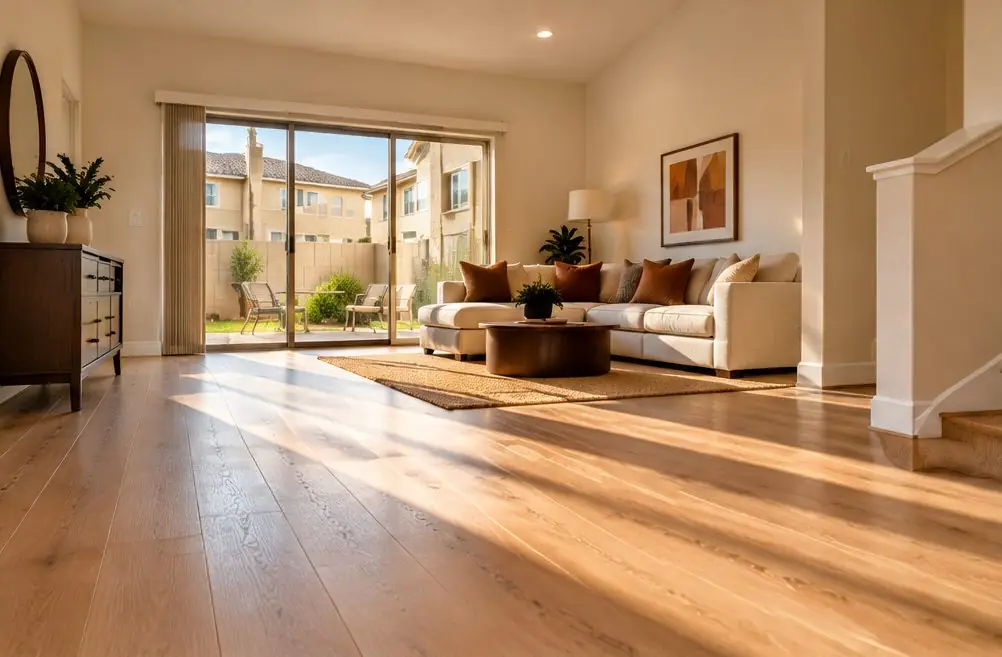
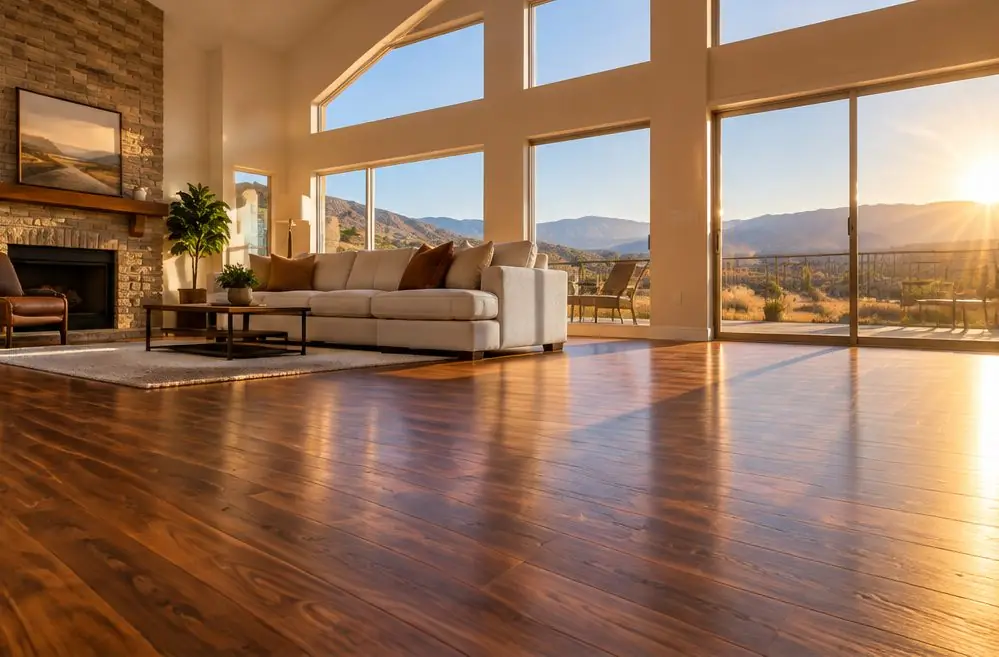
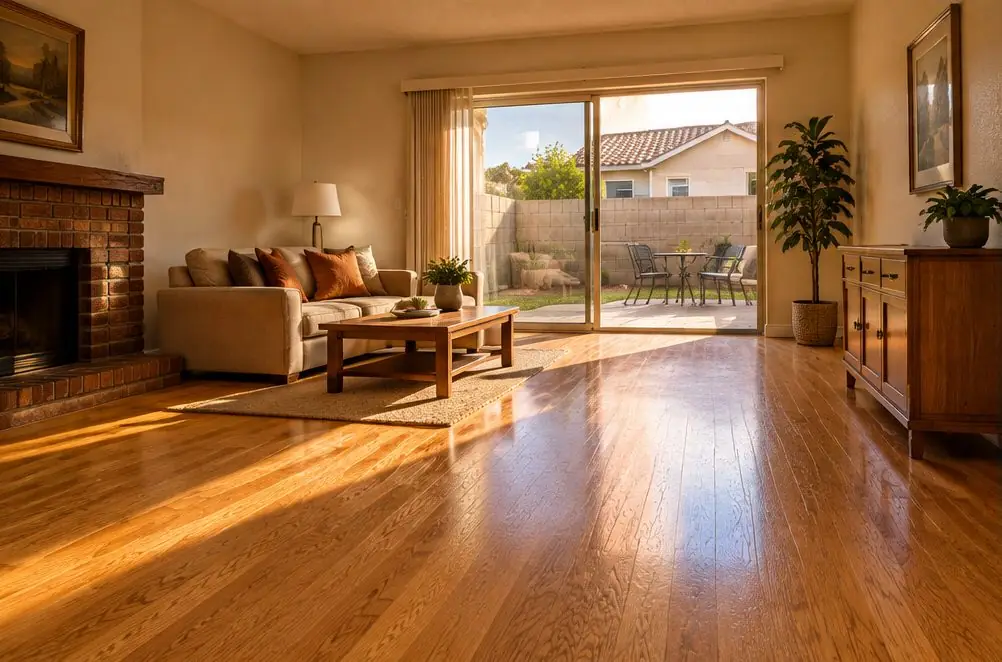
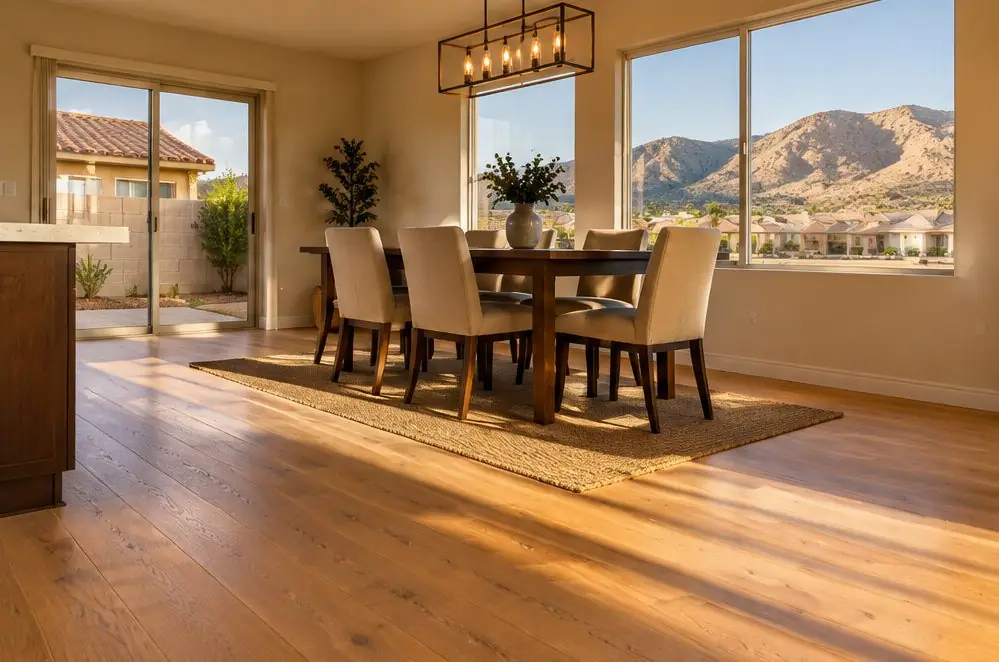
AI-generated illustration. The people shown are not real installers.
One page for each decision: which board, what sits under it, and what the finish has to survive.
A new wood floor for a Fontana house, from the age of the home to the order of work and the price of four typical sizes.
Typically from $8/sq ft

Engineered plank for Fontana houses and townhomes, with what to read on the carton, the three ways it goes down and a priced comparison.
Typically from $8/sq ft

Three-quarter-inch boards for Fontana upstairs rooms and raised-foundation homes, with species, finish and a three-size price table.
Typically from $10/sq ft

Sanding, staining and finishing an existing Fontana floor, with sun-fade notes, a stain-change table and four priced sizes.
Typically from $4/sq ft

Patterned floors for entries and great rooms, with how to choose the plank size, what the waste adds and four priced areas.
Typically from $14/sq ft

Carpeted stairs turned into wood, new treads versus refinishing, how to count steps and what the three size brackets cost.
Typically from $600/job

What dust-contained sanding is, how to compare two bids on it and how to prepare a Fontana house before the machine starts.
Typically from $5/sq ft

A recoat compared with a full sand, with a signs checklist for Fontana floors and a side-by-side price table.
Typically from $2/sq ft

Which gaps are seasonal and which are damage, plus board replacement, squeaks, pet stains and what each fix costs.
Typically from $250/job

What to do in the first two days, how to read the damage and a worked example of a moisture reading, board swaps and a refinish.
Typically from $150/job

The business-floor hub: the four property types, recoat cycles, scheduling around a working space and a priced 2,000 sq ft example.

A turnover timeline and a condition table for landlords, plus the price of a recoat or a sand in three unit sizes.

Entry grit, spills and sun through shop windows: how finish, mats and recoat timing keep a dining or sales floor working, with prices.

A private studio floor in maple, with the finish choice, line paint timing and a price table for three studio sizes.
Take the questions one screen at a time: new floor, refinish or repair, or a rental, shop, office or studio floor. Then the size, the details and the condition of what is there. The total changes with every answer and uses the same Fontana area figures that appear on every page of this site.
Takes about 30 seconds · no sign-up to see your range
Check availability and get your Fontana area price range
Bookings aren't open yet — a typical Fontana range in about 30 seconds.
Fontana grew from the citrus-and-vineyard town of Rosena into a steel town and then into a commuter city, so the year a house was built says a lot about what covers its floor. The table is general; the real floor is checked on site.
| Home built | Likely situation | Typical issue | Refinish or replace? |
|---|---|---|---|
| Before 1970 | Postwar and older houses near Foothill Boulevard, wood floors possible under carpet or vinyl | Wear paths, old wax, lead in older paint, black adhesive under old tile | Check what is under the covering first; often refinish |
| 1970 to 1989 | Early tract homes and condos, mixed floors, many slabs | Worn carpet over a slab, dated tile, mixed subfloors | Mostly new engineered wood; test the slab |
| 1990 to 2009 | The bulk of Fontana's housing, tract homes with builder carpet and tile on slabs | Builder flooring at the end of its life, slab moisture, tile to remove | New engineered floor over a tested slab |
| 2010 and later | Master-planned streets in the north, HOAs, small lots | New concrete still releasing moisture, HOA rules, townhome sound rules | New floor; test the slab and check the HOA |
The median Fontana home was built around 1992, and only about 23% of the housing dates from before 1980, so there is far less original oak here than in coastal or older inland cities. More than a third of homes were built in 2000 or later, and the Arboretum, Summit at Rosena and Monarch Hills projects are still adding houses.
No published figure says how many Fontana homes sit on slabs and how many on raised foundations, so the table speaks only of what is typical for each period. A floor vent or a removed threshold shows the real thickness and subfloor in minutes.
The climate sets a rhythm of its own. July highs average about 95°F, January highs about 69°F, and about 15 inches of rain falls a year, most of it from December to March. Hot, dry Santa Ana winds blow through Cajon Pass, indoor air can dry out sharply, and boards shrink when it does. Dry-season gaps are normal; a humidifier and a steady thermostat reduce them.
Every flooring ad argues for its own product, so this is the side-by-side as plain trade-offs. Cost bands are Fontana labor and material for a typical room, taken from the calculator on this page; the rest is general product behavior, and the manufacturer's instructions decide.
| Option | Typical cost | On a concrete slab | Sand again later? | Common failure |
|---|---|---|---|---|
| Engineered, prefinished standard plank | $8–$12 per sq ft | Yes, glued or floating after a moisture test | Depends on the wear layer the maker states | No slab test, uneven slab, thin wear layer |
| Engineered, wide-plank white oak | $12–$18 per sq ft | Yes, usually glued | Often once or more with a thick wear layer | Wide boards show a floor that is not flat and seasonal movement |
| Solid, prefinished | $10–$15 per sq ft | Only over a plywood subfloor on top of the slab | Usually several times | Laid on a damp slab, wrong gap at walls |
| Solid, sanded and finished in place | $11–$17 per sq ft | Only over a plywood subfloor on top of the slab | Usually several times | Coats recoated before they dry, blotchy stain |
| Herringbone or chevron | $14–$22 per sq ft | Engineered versions glue to a tested slab | Per the product | Layout set out off-square, extra waste |
| Refinish what you have | $4–$6 per sq ft | Not applicable | That is the point; one sanding is removed | Wax or polish under the finish, thin boards |
Cost bands are market estimates, not quotes. No claim about strength or lifespan is made for any row; compare wear layers, written moisture limits and finishes instead.
A rough guide, not a promise. Read the wear layer on the carton, or look at a board edge at a floor register or a lifted threshold.
| Floor | Typical sandings left |
|---|---|
| Engineered, 2 mm wear layer | A screen and recoat, and maybe one light sanding |
| Engineered, 3 mm | Often one or two light sandings |
| Engineered, 4 mm | Often two or three |
| Engineered, 6 mm | Often several |
| Solid, 3/4 in. boards | Usually several over the life of the floor |
—
3/4 in. solid boards usually have about 6 mm above the tongue.
Assumes roughly 1/32 in. (0.8 mm) comes off in a full sanding and some wood stays above the tongue or the glue line. Floors vary; the maker states the limits.
Pick a species, a stain, a sheen, a board width and a pattern. The preview is drawn on screen, so treat it as a rough guide; a sample brushed on your own boards is the real test.
Drawn on screen as an approximation; stain samples on your own floor show the true color.
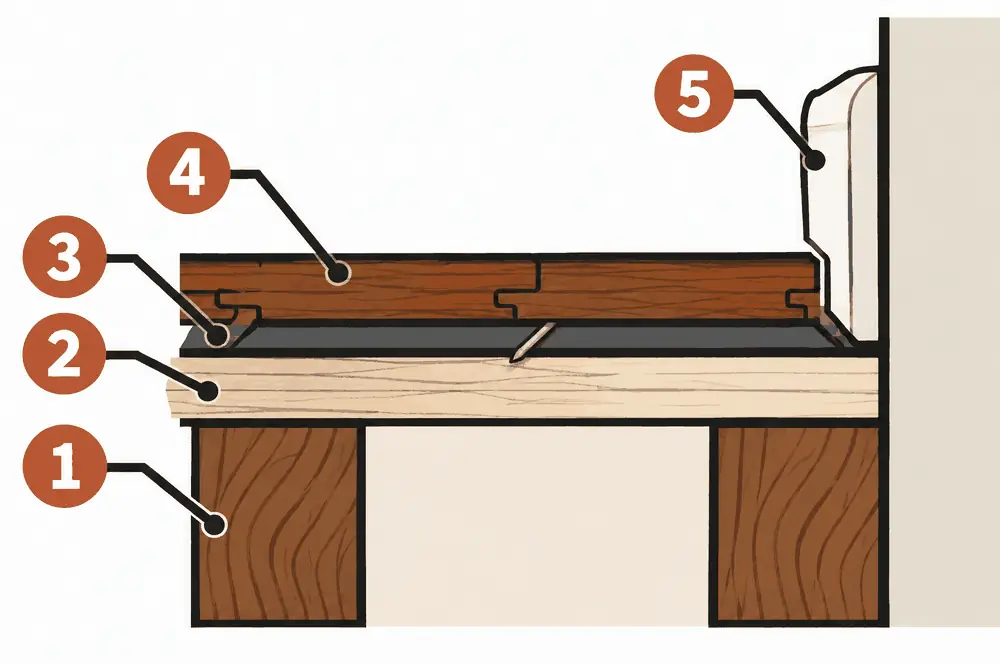
Suits Suits a house on a raised foundation or a room upstairs, where the subfloor is wood. Solid boards can usually be sanded and refinished several times.
Typically $10–$15 per sq ft about $3,000–$4,500 for 300 sq ft, installed
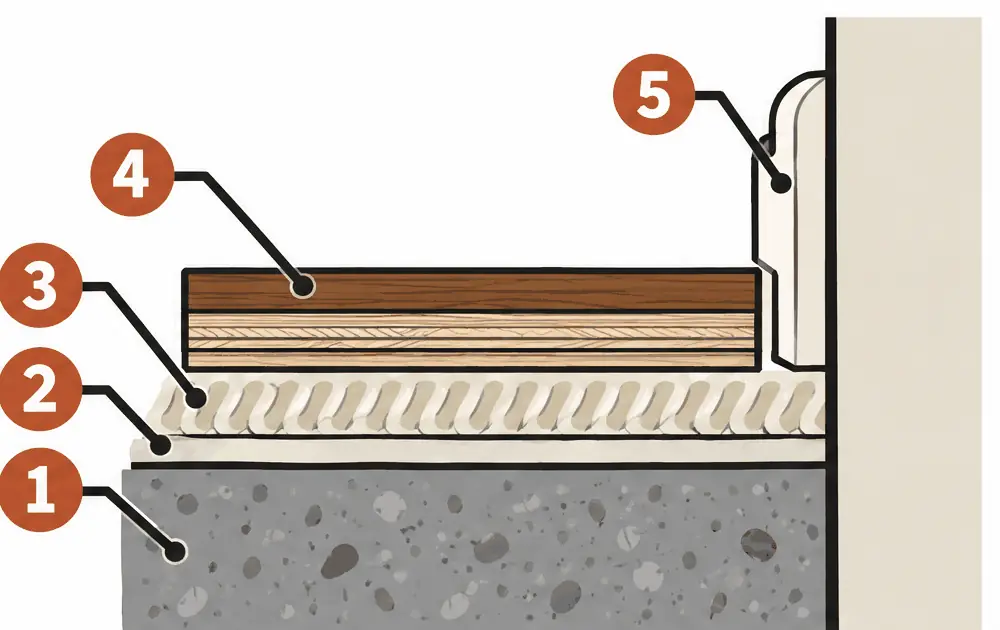
Suits Suits the slab-on-grade homes that fill much of Fontana, once the moisture reading is inside the maker's written limit.
Typically $8–$12 per sq ft about $3,000–$4,800 for 300 sq ft, installed
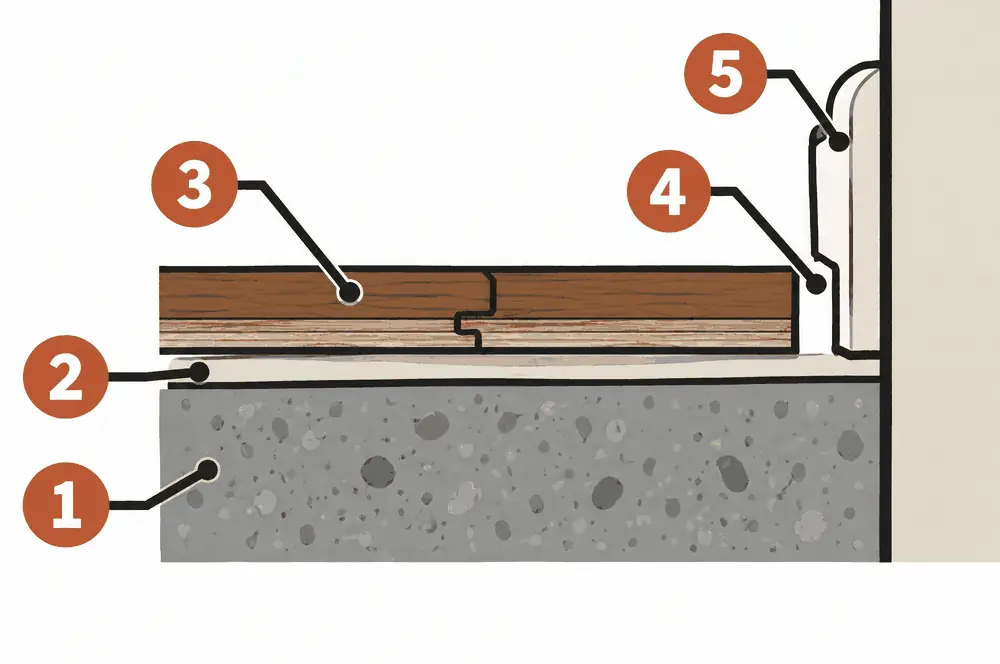
Suits Suits a condo, a townhome or a slab that is flat but should not take adhesive. The underlayment can also add sound control.
Typically $8–$12 per sq ft about $2,700–$4,200 for 300 sq ft, installed
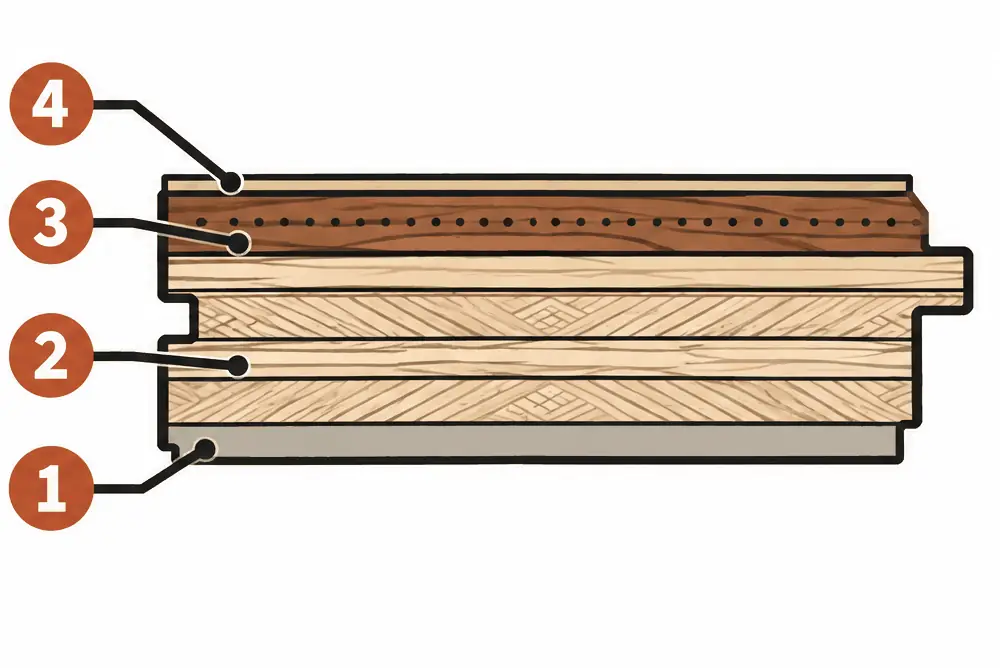
Suits Suits a main living area where wide boards are the point and a thick wear layer keeps a later refinish possible.
Typically $12–$18 per sq ft about $4,200–$6,600 for 300 sq ft, installed
 Illustration
Typical total $2,175–$3,700
 Illustration
Typical total $10,150–$16,350
 Illustration
Typical total $1,190–$2,530
 Illustration
Typical total $825–$1,900
 Illustration
Typical total $3,575–$7,200
 Illustration
Typical total $4,800–$9,900
Hypothetical typical projects. Pictures are AI-generated concept illustrations, not photos of completed installations; no installation was performed or arranged through this site; prices are typical Fontana area market ranges, not quotes.

Between leases: recoat what is still sound, sand what is worn through, keep the gap short.

Heavy foot traffic and grit from the lot; work after closing and a finish chosen for wear.

After-hours zones and a recoat on a schedule so the finish never wears to bare wood.

Maple, a sport-style finish and line paint for dance, yoga or fitness rooms.
A typical order of events. The finish maker's times for the product, the day's temperature and humidity, and the contractor decide; hot dry Fontana afternoons can speed the first dry while the cure still takes its full time. Ventilate, and keep people and pets off until the data sheet allows.
Screen and recoat
Sand, natural, waterborne finish
Sand, stain, oil-modified finish
New prefinished floor
 Inspect and measureThe room is measured, the surface is checked for wax, deep stains, loose boards and raised nails, and paint on pre-1978 floors or trim is tested for lead before sanding starts.
 Prepare the roomFurniture leaves, doorways and vents are sealed with plastic, and the sander is hooked to a vacuum that captures most of the dust.
 Sand through the gritsA drum sander makes passes with coarser and then finer paper, an edger works along the walls, and a last screening pass evens the surface.
 Fill and cleanNail holes and gaps are filled, a few boards may be swapped, and the room is vacuumed and wiped until nothing loose remains.
 Stain and coatAny stain goes down first, then coats of finish with a light abrasion between them, following the finish maker's data sheet.
 Cure and returnFeet, furniture, rugs and pets come back in that order, each only after the times on the data sheet for that day's temperature and humidity.
Check the contractor's license at cslb.ca.gov before signing; work above $1,000 requires one.
For 2026 a typical Fontana range is about $8–$12 per square foot installed for engineered prefinished plank, $10–$15 for solid prefinished, $12–$18 for wide-plank white oak and $14–$22 for herringbone, on a wood subfloor. A slab adds $1–$4, taking up carpet $0.50–$1.50 and tile $2–$5. A 300 sq ft living room in engineered wood comes to roughly $2,400–$3,600 before options. These are market estimates, not quotes.
Typically $4–$6 per square foot for sand and refinish in the natural color, $5–$8 with stain, and $2–$4 for a screen and recoat. A 300 sq ft living room refinished in the natural color runs near $1,200–$1,800 when the floor is in good shape. Wear paths, pet stains and old wax raise that.
Engineered flooring is the type designed for slabs, because its layered build moves less. Solid wood is not glued to concrete; if it is used, it goes over a plywood subfloor laid on the slab. A moisture test comes first either way, and the maker's written limits control.
Solid hardwood can usually be sanded and refinished several times. For engineered flooring the answer depends on the wear layer thickness the maker states, and a floor vent or a removed threshold shows what the board is made of. A screen and recoat renews the finish without sanding to bare wood.
Sanding makes fine dust. Many refinishers connect the sander to a vacuum that captures most of it, seal doorways and vents with plastic and clean afterward, though some fine dust still settles. The guide on this site explains what 'dustless' does and does not promise.
Wood shrinks as the indoor air dries, and Santa Ana winds through Cajon Pass can pull humidity down hard in fall and winter. Thin seasonal gaps are common and often close again. Boards that cup or buckle point to moisture instead.
Often yes, but many associations require an acoustic underlayment with a stated sound rating and written approval first. The CC&Rs decide, and a lab rating is not a field test.
A screen and recoat can take a day or two. A full sand and finish takes longer, usually several days with drying time, and the finish maker's data sheet sets when people, rugs and furniture can return.
In homes built before 1978, paint on floors or trim can contain lead, and old vinyl tile or black adhesive under an old floor can contain asbestos. Both are tested before sanding or removal.
Yes. The Business & rentals pages cover rental turnover floors, restaurant and retail floors, private dance, yoga and fitness studios and commercial refinishing, with their own path in the calculator.
Homes and businesses across Fontana, CA — historic downtown and Foothill Boulevard, central Fontana, Sierra Lakes, Summit Heights, Summit at Rosena and the Arboretum, Coyote Canyon and Hunter's Ridge, Southridge Village, and Jurupa Hills. The availability check shows whether bookings are open for a ZIP.
Contractors featured on this site are independent businesses. The contractor's legal name and business details are published on this site before bookings open. Warranty terms, if any, are set by the contractor and the manufacturer; ask what is covered, for how long, and what is excluded.
Hardwood Floors Walnut Fontana covers Historic Downtown and Foothill Boulevard, The Arrow Corridor, Sierra Lakes, Summit Heights, Summit at Rosena and the Arboretum, Coyote Canyon and Hunter's Ridge, Southridge Village, Jurupa Hills and South Fontana — pick your neighborhood from the menu for local details and ZIP codes.
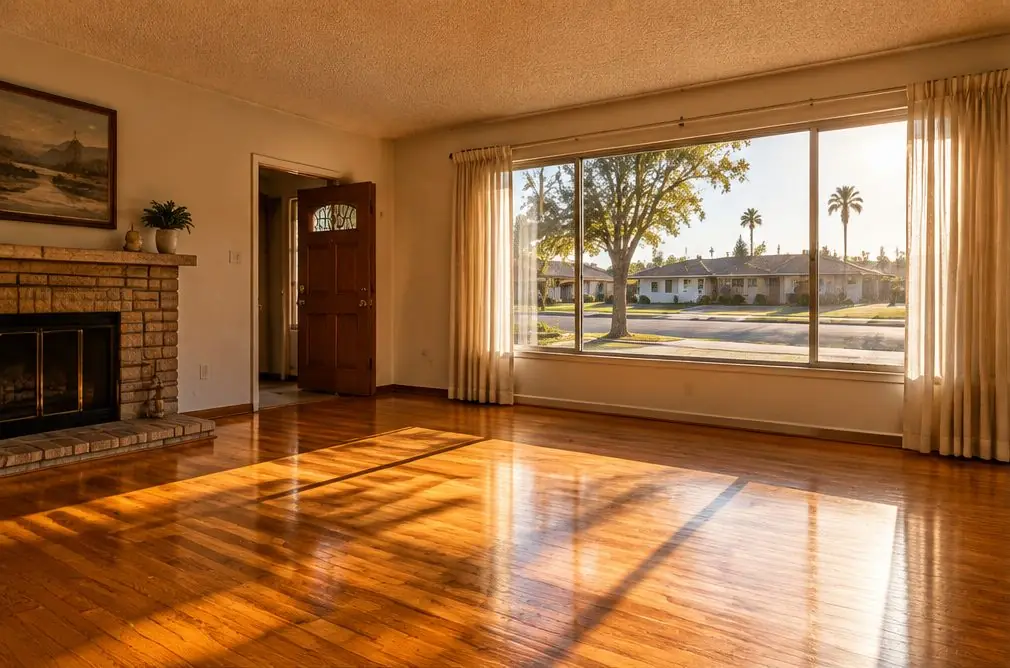
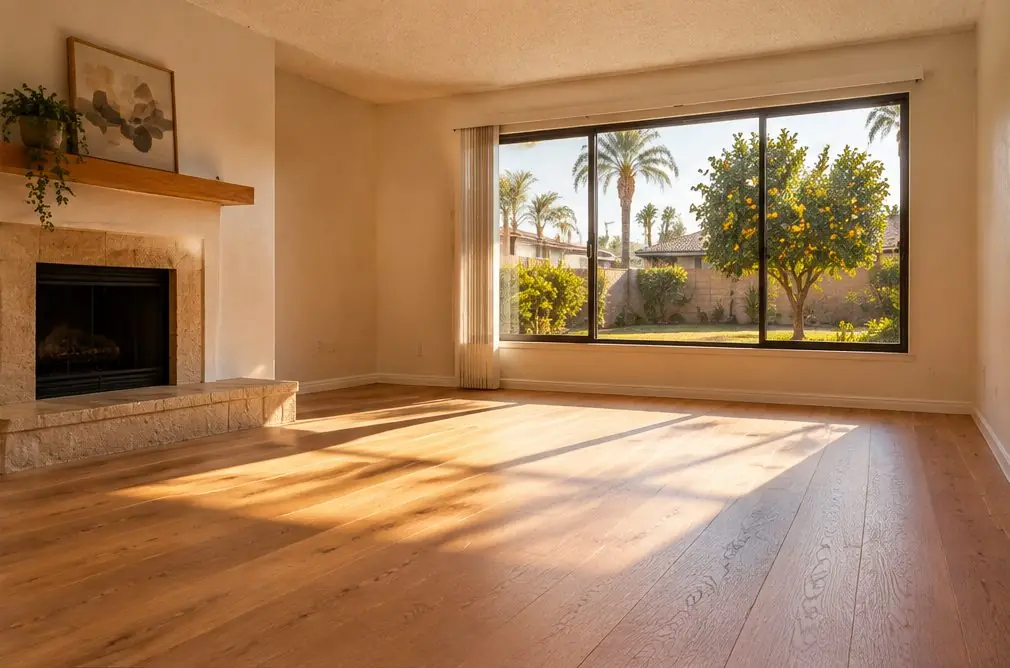
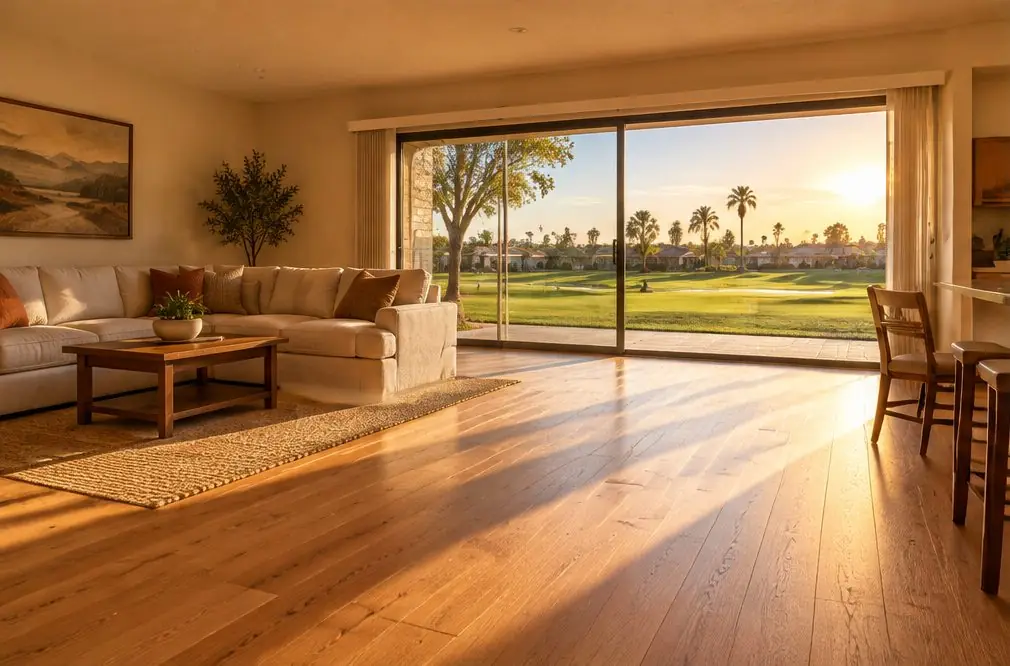
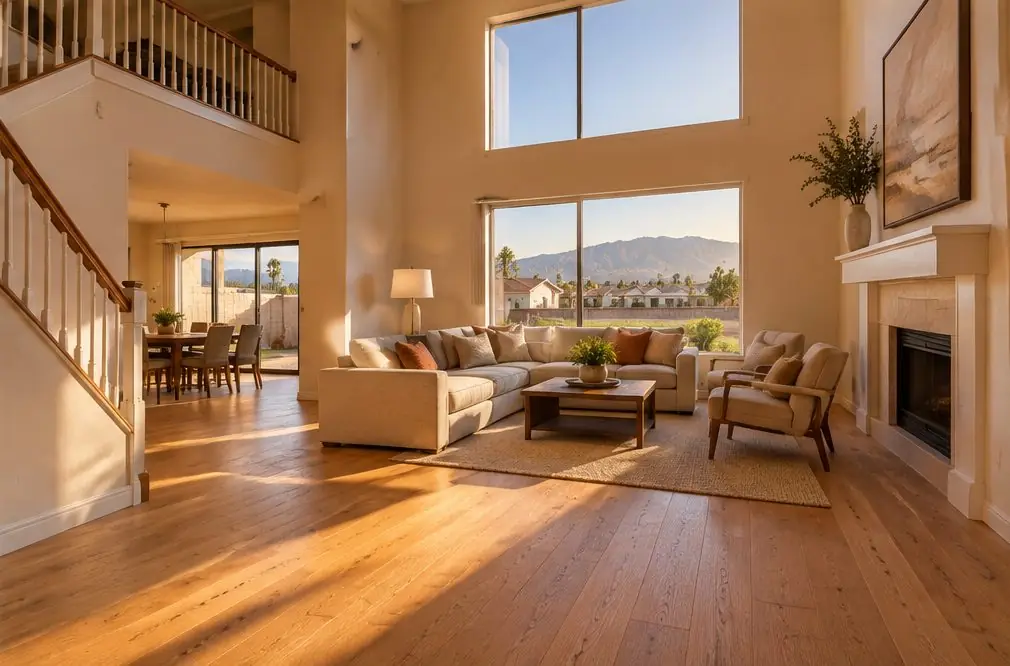
What a Fontana hardwood floor typically costs, square foot by square foot
Choose a new floor, a refinish or a business floor, then the size and the details, and see the range. No contact details needed. Bookings open on this site once a local flooring contractor is named.